
A Pragmatic Approach
Ask, Don’t Assume
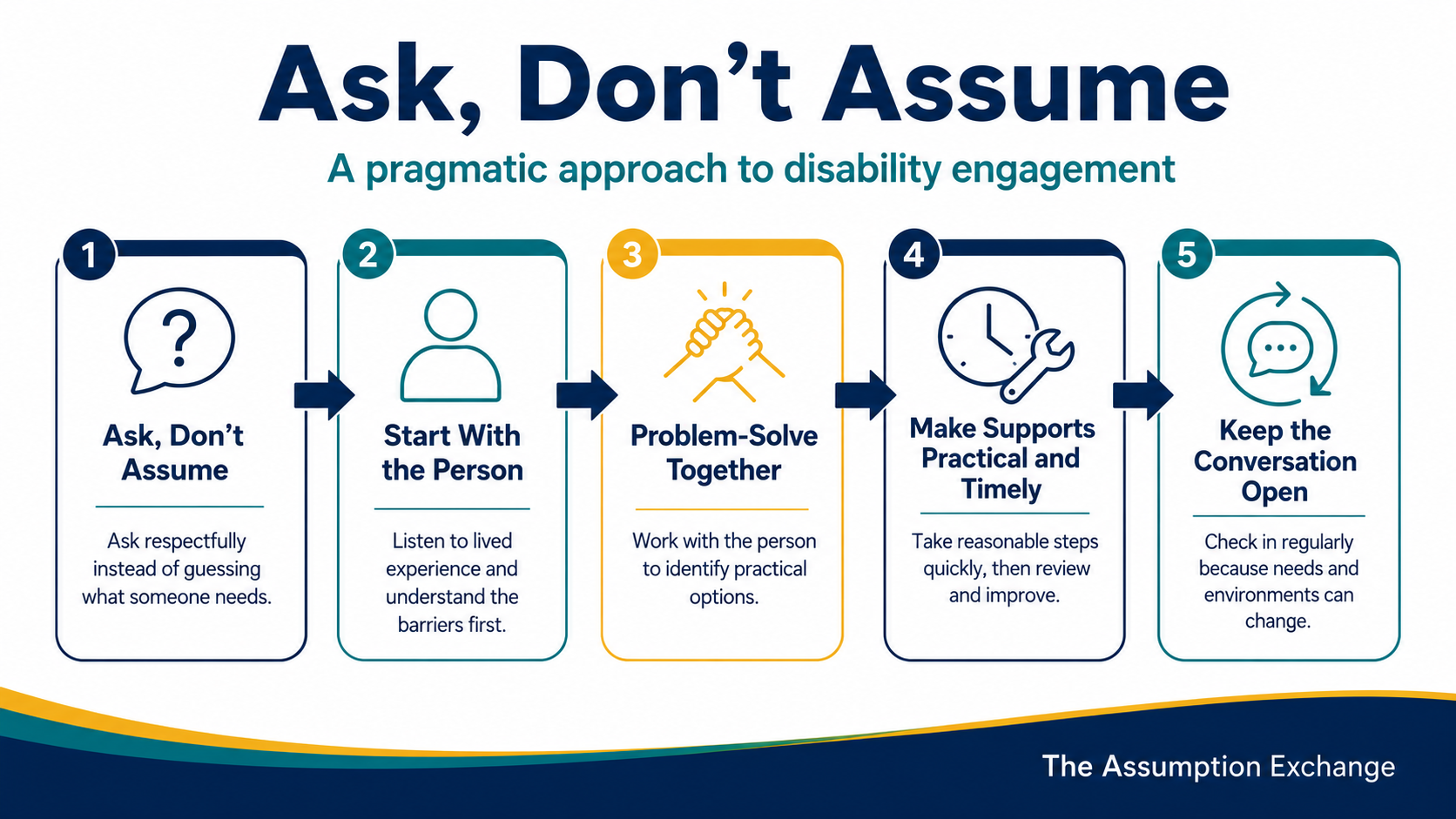
A pragmatic approach to disability engagement starts with a simple principle: do not make assumptions about what a person can do, what they need, or what will help. It is better to ask respectfully than to guess incorrectly. Saying, “I’m not sure what would be most useful here — can I ask what support would help?” creates space for an honest conversation and shows that the organisation is willing to listen, learn, and respond.
Start With the Person
Every person’s experience of disability is different, so support should be shaped through conversation rather than a standard checklist. Engage directly with the individual, ask what barriers they are experiencing, and explore what would make participation easier, safer, or more effective. This keeps the focus on the person’s lived experience and avoids creating solutions that look good on paper but do not work in practice.
Problem-Solve Together
Disability engagement works best when it is collaborative. Rather than treating adjustments as a complicated or formal process from the outset, work with the person to identify practical options. Ask what has worked for them before, what they would like to try, and what small changes could make an immediate difference. Often, the most effective supports are straightforward, low-cost, and easy to implement when people are willing to have the conversation.
Problem-Solve Together
Disability engagement works best when it is collaborative. Rather than treating adjustments as a complicated or formal process from the outset, work with the person to identify practical options. Ask what has worked for them before, what they would like to try, and what small changes could make an immediate difference. Often, the most effective supports are straightforward, low-cost, and easy to implement when people are willing to have the conversation.
Make Supports Practical and Timely
Support does not need to be perfect before action is taken. A pragmatic organisation looks for reasonable, workable steps that can be implemented quickly, reviewed, and improved over time. This might include changes to communication methods, meeting formats, workspaces, technology, flexibility, or access arrangements. The key is to remove barriers in a way that is practical for the person, the team, and the organisation.
Keep the Conversation Open
Disability engagement is not a one-off discussion. Needs can change over time, and supports may need to be adjusted as roles, environments, or circumstances change. Build in regular, respectful check-ins and make it clear that people can raise concerns or request changes without fear of judgement. An open, responsive approach helps create a culture where people feel confident asking for what they need and where inclusion becomes part of everyday practice.